The Hunter – A Day in the Life of Sun Outdoors columnist, in the historic woods of Fairmont Kenauk in Montebello

(Originally published in The Ottawa SUN November 23, 2008)

White-tailed deer hunting, for me, is part of a lifelong obsession with soaking up Mother Nature like a sphagnum moss. The deer woods are a magical place where I find solitude and learn a bit more about myself. You just never know what might appear over the knoll or through the next cedar swale.

I find myself back in the historic woods of Fairmont Kenauk in Montebello – where the stands of mature hardwoods and rolling hills beckon. While pursuing the elusive whitetail, the setting is typically universal; but there is something about the mountains and crisp, cool air to set the stage for the perfect hunt.

4 a.m.

The alarm bell breaks the drone of three snoring hunters, signalling the start of another deer hunt. “Let’s do this right,” I think to myself from under the flannelette sheets. Although my mind is filled with visions of large-antlered ungulates, I try to stay focused.

4:15 a.m.

I roll out of bed and reach for my flashlight as a grunting sound billows from the next room. “Well, the deer aren’t gonna shoot themselves;” my father declares. The gas-powered Coleman coffee maker gurgles, as a misty fog drifts across the window of Muskrat chalet – our home for the next two days.

4:50 a.m.

As we nibble on the last few slices of half-charred toast, a plan is hatched. “With fresh snow on the ground, we should explore the territory for deer movement;” suggests the elder Morrison. Since age and experience carry more weight during a deer hunt – at 76 years old and 64 deer seasons to his credit – we all agree.

5:30 a.m.

I fall into my role as team catalyst and gadget guy. Deer scent dispensers refilled, two-way radios checked for battery power and GPS units accounted for. Three neat piles are laid out on the kitchen table.

6:25 a.m.

We begin our ‘recon’ of the territory using the fresh snowfall to our advantage, a map and GPS also at the ready. If there are any deer around, we should know right away.

6:45 a.m.

Down the road, the clearly visible claw marks in the snow confirm the presence of Ursus Americana. Although bear attacks are rare, just knowing they’re around, sends a chill up my spine.

7:30 a.m.

We find a fresh set of coyote tracks crossing the road too, but after full hour of scouting still no sign of deer. Perhaps last winter was harder on the herd than I imagined?

8:45 a.m.

After splitting up and walking a serious of trails, we finally locate some tracks. An active “runway” intersects a logging road where several fresh doe and fawn tracks can be seen in the mud.

8:50 a.m.

My father and I locate a good perch to watch for movement – mine is a large moss covered, boulder about 40 feet across, Jim heads back up the road to do a walk-through.

9:30 a.m.

Apparently, the cigar I smoke the night before was a bad idea, as I choke back a nagging tickle. I also listened to Metallica’s Master of Puppets in my truck on the way into Kenauk, I suppose my ears will be the next to go!

9:40 a.m.

A red squirrel tears back and forth in a torrent rustling of leaves, stopping to scold me each time. You’ve never felt utter rejection until being scorned by an angry squirrel.

10 a.m.

With my raspy throat clearing up and not a squirrel in sight, a thumpity thump sound comes from up the hill. The silhouette of a deer with its nose to the ground materializes at 75-yards. It’s a buck and big one too!

10:01 a.m.

My heart rate jumps into turbo overdrive as the big mature male sneaks toward me – oblivious to everything but the fresh doe tracks he’s trailing. I quickly find him in my scope and prepare for a shot. The big boy makes the perfect turn to expose his vitals, and the bark of my trusty 30-06 Mauser echoes through the mountains.

10:15 a.m.

I kneel beside my beautiful 12-point trophy in admiration. I estimate his age to be 4.5 years with a large body, symmetrical crown and nice forked brow tines. A very nice, unexpected surprise.

11:10 a.m.

Waiting for the men to arrive, I pull a drink from fanny pack to celebrate. With a strict no-alcohol policy in place during hunting hours, a large can of Cheetah Power Surge gives me a much-needed dose of rejuvenation.

1:35 p.m.

After field dressing the buck and having a bite to eat, we head deeper into the wilderness to escape in quiet reflection.

4:30 p.m.

Darkness closes in over the Kenauk forest as we make our way back to camp. Between walking the trails, the chattering squirrels, and harvesting a truly magnificent animal, it has been one heck of fulfilling day in the life of a hunter.

(Originally published in The Ottawa SUN November 23, 2008)

NEW Hunting & Fishing Articles!

Be sure to visit my recently updated website, with a section called; NEW Hunting & Fishing Articles – brand-new hunting, fishing, conservation material for your enjoyment! Everything from tips on Hunting the mountains, to learning how to properly spool a fishing reel, to trailering or winterizing an RV with success!

Enjoy the articles and check-back for new material coming regularly!!

Exciting Hunting/Fishing Website – Hook & Bullet.com

I invite all avid anglers and hunters out there to a website I manage called, Hook and Bullet. The site focuses on getting folks outdoors – to help plan your next adventure: where to go, when to go, what to pursue and what gear to bring.

We host the largest database of North American bodies of water, where you can find the best places to fish and hunt. We’ve already received over 250,000 fishing reports and have close to a million pages of content focused on fishing and hunting.

I am pleased to feature new Outdoors Guy insight and content regularly, on almost every aspect of hunting, fishing, camping, outdoor survival, and conservation including stories near and dear to my heart. Hope to see you there!!

Please visit: http://www.hookandbullet.com/

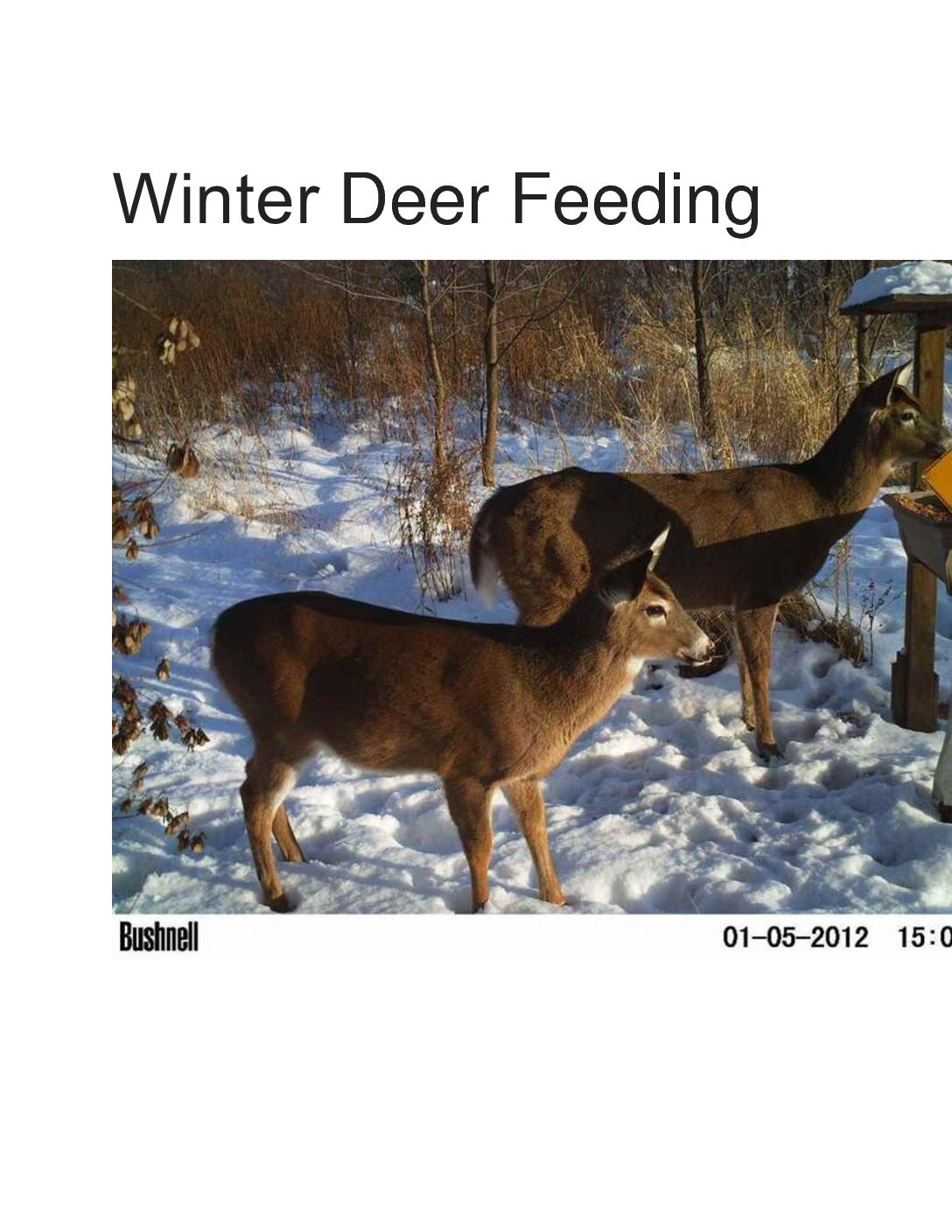
A GUIDE TO BACKYARD DEER FEEDING

A conservationist’s tips for feeding (and photographing) your backyard deer. Enjoy the thrill of your own backyard with this handy guide to feeding whitetails.

(Note: Techniques described in this article are merely suggestion, please consult your provincial guidelines for supplemental deer feeding)

As a dedicated whitetail conservationist and wildlife biologist, I have managed winter whitetails for more than 25 years. From deer yard operations in the mountains of Quebec, to counting pellet groups in Central Ontario as part of a Ministry of Natural Resources (MNR) Fish & Wildlife initiative, to today running my own small scale backyard feeder in Eastern Ontario, working with Ontario’s deer populations has been an incredible part of my career.

Helping our ‘deer friends’ endure the colder months is a pet project of mine and it can be yours too. If you’ve noticed deer in your backyard or neighbourhood over the years, now is a great time to learn more about backyard feeding. Here’s a handy guide to help get you started! The rewards of backyard deer feeding are well worth it. In the spring, I see fawns born that develop into mature majestic bucks, who later return to my feeder each winter. Knowing I play a small part in the ‘whitetail circle of life’ is a good feeling indeed!

Meet the White-tailed Deer

White-tailed deer or Odocoileus Virginianus are a wide-ranging ungulate native to North America and South America and found in most parts of Ontario. Whitetail body size varies greatly throughout its range, following Bergmann’s rule, where deer of the south are generally smaller, while those in northern climates like Northeastern Ontario tend to be larger. An adult whitetail can weigh between 150 – 250 pounds, on the hoof.

Tips on backyard feeding

Backyard deer feeding is an enjoyable pastime and of benefit to whitetails as snow depth increases. I learned a few tricks to assist with your own backyard feeding, starting with the number 1 rule of winter deer feeding, consistency. Once you begin distributing supplemental feed, it is imperative to continue throughout the winter, as a whitetail’s digestive system adapts to your supplemented diet. Understanding the basics before you start feeding, will go a long way to ensuring a more productive and helpful winter program. It is easy to do with a few simple tips.

Backyard feeding VS Deeryard Management

While government agencies operate larger scale deer stations in northern Ontario deeryards to help manage winter whitetail populations, it is much easier to run your own small-scale backyard feeder – as long as you follow these handy tips. Please note that supplemental feeding is not the same as a full-fledged deeryard operation, or an emergency feeding situation. Your backyard feeder will serve only as a small ‘supplement’ to the deer’s natural winter browse intake, akin to feeding song birds at a bird feeder. We are not there to replace a whitetail’s natural diet entirely; this is one of the many misconceptions of backyard feeding.

This guide covers supplemental feeding of a small number of deer, usually less than 10. I generally provide feed for 6-8 whitetails each winter.

Deer benefits

The main motivation for backyard feeding is to prevent loss of wintering deer due to starvation. Whitetails in the northeast contend with deep snow, limited access to natural forage and increased predation. Supplemental feeding is an asset to the herd as a whole. Younger deer have higher energy demands and with increased difficulty wading through deep snow, winters are especially hazardous.

Mature bucks enter the colder months having depleted fat reserves during the rut and when winters arrives, they are often in a weakened state; unable to replenish important fat levels. Studies have shown that doe’s with improved winter nutrition have fewer fawns die at birth, and increased fecundity rates, or the delivery of multiple fawns. Improved winter diet is beneficial to all members of a whitetail population, and is the cornerstone of any backyard feeding.

Feed options

After years of experimenting with different feed types, I settled on ‘livestock grower pellets’ from Ritchie Feed & Seed, in Ottawa. These grower pellets are composed of 14” Protein, 8 % Fiber, 3 % crude fat and 1% calcium and available at many other livestock feed stores in Ontario’s northeast: Krause Farm Feeds in Powassan, and Valley Farm & Feed in Chelmsford. Take note that the use of whole corn, whole wheat or whole barley cause digestive issues for deer, since these foods are high in starch.

Daily feeding

For the small number of deer that visit my backyard feeder, 1-2 litre ‘scoops’ of feed per day will suffice. Deer usually only feed for 2-3 minutes and then move on to their natural winter browse. I make sure to have feed in my feeder at all times that is dry and accessible. If I plan to be away for more than a day, I arrange for someone to top-up the feed so it never runs out.

Backyard Pitfalls

One pitfall of winter-feeding is its impact on deer density. Large-scale feeding operations can increase whitetail numbers, thus depleting natural forage supplies. This ties-in with the concept of carrying capacity or the environment’s ability to offer life support for a set number of animals, based on available resources. The goal with any backyard feeding is to offer just a small supplement and not to replace natural feed completely. Keep your backyard feeding small scale; cater only to a small handful of deer.

Helping the offspring

One devastating hidden effect of a harsh winter is observed with adult does, and often results in death of fawns during birth. Studies have shown that females with improved winter nutrition have fewer fawns die at birth, and increased fecundity rates, or the delivery of multiple fawns. Improved winter diet is beneficial to all members of a whitetail population, and one reason why we offer supplemental winter feed.

Conservation at work

As active conservationist of Ontario’s northeast, assisting deer populations during difficult months is both fun and beneficial. Maintaining a small backyard feeder has offered me an intimate glimpse into whitetail behaviour, rarely seen, and made for great photo opportunities. Good luck with your own backyard whitetail feeding. Our deer friends thank you.

Winter fun in the great outdoors!

With another winter fishing season well under way, ice anglers are reminded to always keep ice safety as the number one concern.

Winter anglers out on the ice this month should always let someone know where they will be fishing, and when they plan to return. It makes good sense from a safety standpoint! I would also recommend if you travel on our frozen lakes, and rivers with an ATV, snowmobile or passenger vehicle, do not venture far off the beaten path. Too many folks have gone through the ice this winter, especially in Quebec where six snowmobilers plunged to their death, after venturing away from the established trail on massive Lac Saint Jean. Two snowmobilers were pulled to safety from the icy waters in Prince Edward Country last week, and another person was rescued from Rice Lake in the Kawartha Region.

Stories like these reinforce the need for improved vigilance while travelling on the ice, so please be careful this winter.

Proper attire

Appropriate winter clothing and specialized equipment are also good safety measures. Some anglers use heavy survival suits and even carry sets of ice picks, while others go so far as driving modified ‘ice cars’ with the doors and windows removed, in case of an untimely plunge. Tearing-off your car doors is extreme but the point is that ice can crack in a moment’s notice regardless of the conditions. Remember that ice will not freeze at a uniform thickness, especially near at the start of the season where near-shore ice is always thicker than ice further out. Ice over flowing water, or near the presence of springs, is especially dangerous and unstable.

Deer feeding

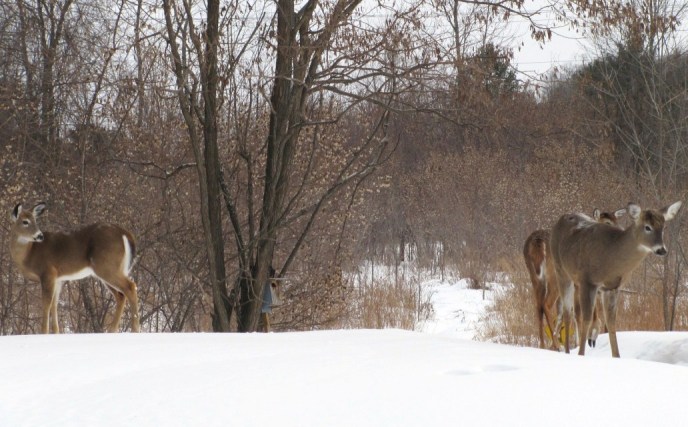
It has been an enjoyable winter thus far ‘deer-wise’ on my property, one of those rare years when my whitetail herd did not flee with the arrival of January’s snowfall. Observing winter whitetail behaviour is a fascinating pastime. The herd dynamic is different in the colder months than it is the rest of the year; however, a definite hierarchy remains in place. The older, more mature animals eat first leaving the fawns to fend for themselves. Even adult does in a family group take precedent, before allowing their yearling offspring and fawns to feed. I always make sure to have several feed locations available, away from my main feed trough to avoid competition.

Despite what some armchair conservationists might believe, this small-scale supplemental feeding program will not hinder the whitetails’ chance at survival. It is akin to feeding birds at a bird feeder. Most of the whitetail’s winter diet is composed of tree browse. The province of Quebec has even go so far as to ban winter whitetail feeding, with the recent Chronic Wasting disease (CWD) scare. I have hopes that this widespread panic will not make its way into Ontario.

Quebec Outfitters Federation Website

All you hunting and fishing enthusiasts who plan to visit Quebec this year should check out the Quebec Outfitters Federation website. With a full array of camps, cabins and lodges opportunities throughout the province, the Outfitters Federation Site lays-out suitable vacation destinations for whatever outdoor pursuit is your preference. Just across the river, in the Outaouais region alone, there are 31 hunting and fishing outfitters catering to avid sportsmen, and women alike. I have visited several of the Province’s lodges over the years for bear, moose and deer hunting, as well as top angling opportunities. If you are considering a hunting or fishing trip of a lifetime this winter, or spring, visit the Quebec Outfitters Federation (QOF): http://www.hunting-fishing.quebec

Bounder magazine – spring issue

With spring just around the corner, keep an eye out for the spring issue of Bounder Magazine. The popular men’s magazine is available at Stinson’s in Pembroke and many other locations around the Ottawa Valley. For more information on Bounder magazine: http://bounder.ca/

BIG FOOT image captured on Washington State Traffic Cam!!

The Internet is abuzz this week with news that a Big Foot has been spotted on a Washington State Government Traffic Cam! Man, this is exciting!

The image does appear to show a tall, dark creature lurking along the treeline and looking very much ‘Sasquatch Like’. Can you imagine if it really was Big Foot? It sures matches the description.

I have read many articles, seen scads evidence of foot prints, hair samples and watched that famous Patterson-Gimlin video a million times. I truly believe that Gigantopithecus is real and it is only a matter of time that we find solid evidence of its existence.

Have you heard the audio from earlier this summer, taped in Northern Ontario? Strange howls, something very large and almost otherworldly, not quite wolf and not quite bear. I have seen vids of similar strange howling captured on Vancouver island, and other parts of the Pacific Northwest. There is something out there!

What do you believe? Drop me a note or share your own Big Foot theory!
Outdoors Guy

Possible return of Ontario’s Spring bear hunt

The province of Ontario announced this week, they are considering a reinstatement of the Spring hunting season for black bears, but with some stipulations – a decision being met with controversy.

This is what the Publication; Dryden Now had to say. I would love to hear your thoughts on this:

Local hunters are being asked for their input, after a successful pilot program across Ontario. The annual hunt was cancelled in 1999.

In 2014, the province introduced a spring black bear hunting season pilot to support the sustainability of black bear hunting. It’s continued each year, and now the province is hoping to make the pilot program a regular, annual spring hunting season. 25,000 bear hunting tags were sold each year of the pilot, which was expanded and improved upon in 2016.

“Ontario is home to a healthy bear population,” said Natural Resources Minister John Yakabuski. “The province will continue to monitor black bear populations, harvest results and sustainability indicators to inform an annual review and ensure bear populations are managed sustainably.”

As part of this proposal, all protections for Ontario’s black bear population would remain in place. For example, it would remain illegal to harvest black bear cubs and females with cubs in the spring, a crime that carries a potential fine of up to $25,000 and up to one-year imprisonment.

“We are listening to the concerns of northern Ontarians and the tourism industry that an ongoing pilot spring season creates economic uncertainty,” said Yakabuski. “A regular, monitored spring bear hunting season would enable tourism outfitters and camp owners to better plan their operations for the entire year, while also allowing hunters to better plan their activities and support local businesses.”

The province is also proposing to eliminate special black bear hunting opportunities for non-resident landowners and non-residents hunting with immediate relatives, and requiring people guiding resident bear hunters for commercial purposes to obtain a licence to provide black bear hunting services.

The province is hoping to gather the public’s feedback and opinions on the proposed hunting season changes, and feedback is being openly accepted until February 18, 2020. The link can be found below.

In September of 2019, the Ministry of Natural Resources and Forestry warned the public of a high amount of bear sightings and interactions in the area, despite calls being down overall in Ontario. Two bear attacks, leading to one fatality, took place over that month.

The ministry is reminding the public that bears are often attracted to things such as garbage, bird food, odours from barbecues and ripe fruit left on trees or on the ground. Removing these attractants can help keep bears out of the area.